
Badminton history: how a lawn game got its name and its rules
Badminton history starts with battledore and shuttlecock, a keep-it-up game played for centuries, which British officers in India turned into a net game in the 1860s. It took its name from Badminton House in Gloucestershire, and got its first written rules in 1877.
Badminton history before the net: battledore and shuttlecock
For most of its life, the shuttlecock game had no net, no court, and no loser. Battledore and shuttlecock — the battledore being a small wooden bat — was cooperative: two players kept a feathered cork in the air as long as they could, counting hits rather than points. Versions of it turn up across Eurasia. China's jianzi is kicked instead of struck, Japan's hanetsuki uses flat decorated paddles, and English households played battledore in halls and gardens well into the nineteenth century.
The old equipment left its fingerprints on the modern game. "Shuttlecock" describes exactly what the object does — it shuttles back and forth, the way a weaver's shuttle crosses a loom — with "cock" for the feathers. A standard feathered shuttle still has 16 feathers set into a cork base, which is why it decelerates harder than any other projectile in racket sport.
Who invented badminton, and where did badminton originate
No single person invented it. The change that turned a pastime into a sport — a net, two sides, and a way to lose — happened among British Army officers stationed in India during the 1860s, and it is most closely associated with the garrison town of Poona, now Pune in Maharashtra. Officers played the old shuttlecock game across a net on a lawn or a mess-room floor, added scoring, and in the 1870s wrote local rules down. The game then traveled home in their luggage.
So badminton's origin country depends on which question you're asking. The net game was assembled in India; the name, the first clubs, and the first published rulebook came out of England. Both answers are honest, and a source that gives you only one is simplifying.
Why is it called badminton
Badminton House in Gloucestershire is the seat of the Dukes of Beaufort, and the sport is named after it — one of very few sports that took its name from a building. Officers back from India played there at house parties, guests started asking for "the Badminton game," and the label stuck to the sport and never came off.
The date usually given is 1873, but the party is a tradition rather than a documented event. Nobody at the time thought a lawn game needed recording, so the year should be read as approximate. The estate is better known today for the Badminton Horse Trials, held there since 1949.
The first rulebooks: Bath in 1877, a national association in 1893
The Bath Badminton Club, formed in 1877, produced the first written rules of the modern game in England. They were local and idiosyncratic, and they described a court shaped like an hourglass — wide at the back, pinched at the net — because the game was often played in drawing rooms where the doors opened onto the middle of the floor.
In 1893 the Badminton Association of England was founded and issued a standard rulebook. That's the point at which badminton stops being a collection of house customs and becomes a sport you can hold a championship in. The All England Championships followed in 1899, with doubles events only; singles arrived the next year. The waisted court survived in the laws until 1901, when the rectangle replaced it — and the court dimensions have barely moved since.
From the IBF to the BWF
Nine national associations founded the International Badminton Federation in 1934: Canada, Denmark, England, France, Ireland, the Netherlands, New Zealand, Scotland, and Wales. India, where the net game had been assembled, joined as an affiliate two years later. The IBF renamed itself the Badminton World Federation in 2006.
Team competition came after the war, with the Thomas Cup for men first held in 1948–49 and the Uber Cup for women in 1956–57. The Olympic route was slower: a demonstration event in Munich in 1972, an exhibition in Seoul in 1988, full medal status in Barcelona in 1992, and mixed doubles added in Atlanta in 1996.
How the scoring changed, and why your scoresheet looks like this
Until 2006 badminton used service-only scoring, also called side-out scoring. You could only add a point to a rally you had served; win a rally on your opponent's serve and you won the serve, not a point. Men's singles and every doubles discipline played to 15, women's singles to 11, and at 13-all or 14-all the side that got there first could "set" the game, extending it rather than playing a two-point finish. In doubles, each side got two serves — one for each partner — before the serve passed to the other side, except the very first service of the game, which counted for only one serve.
That made match length wildly unpredictable, with long stretches where the score didn't move. Rally scoring — every rally is worth a point, whoever served — was tested from 2005 and made permanent in 2006. Games go to 21, you need a two-point margin, and the game is capped at 30, so at 29-all the next point ends it. Matches remain best of three games.
| Service-only (until 2006) | Rally scoring (2006 onward) | |
|---|---|---|
| Points per game | 15; 11 in women's singles | 21 in every discipline |
| Who can score | The serving side only | Whoever wins the rally |
| Close finishes | "Setting" at 13-all or 14-all | Win by two, hard cap at 30 |
| Serves per side in doubles | Two, one for each partner | One |
| Match format | Best of three games | Best of three games |
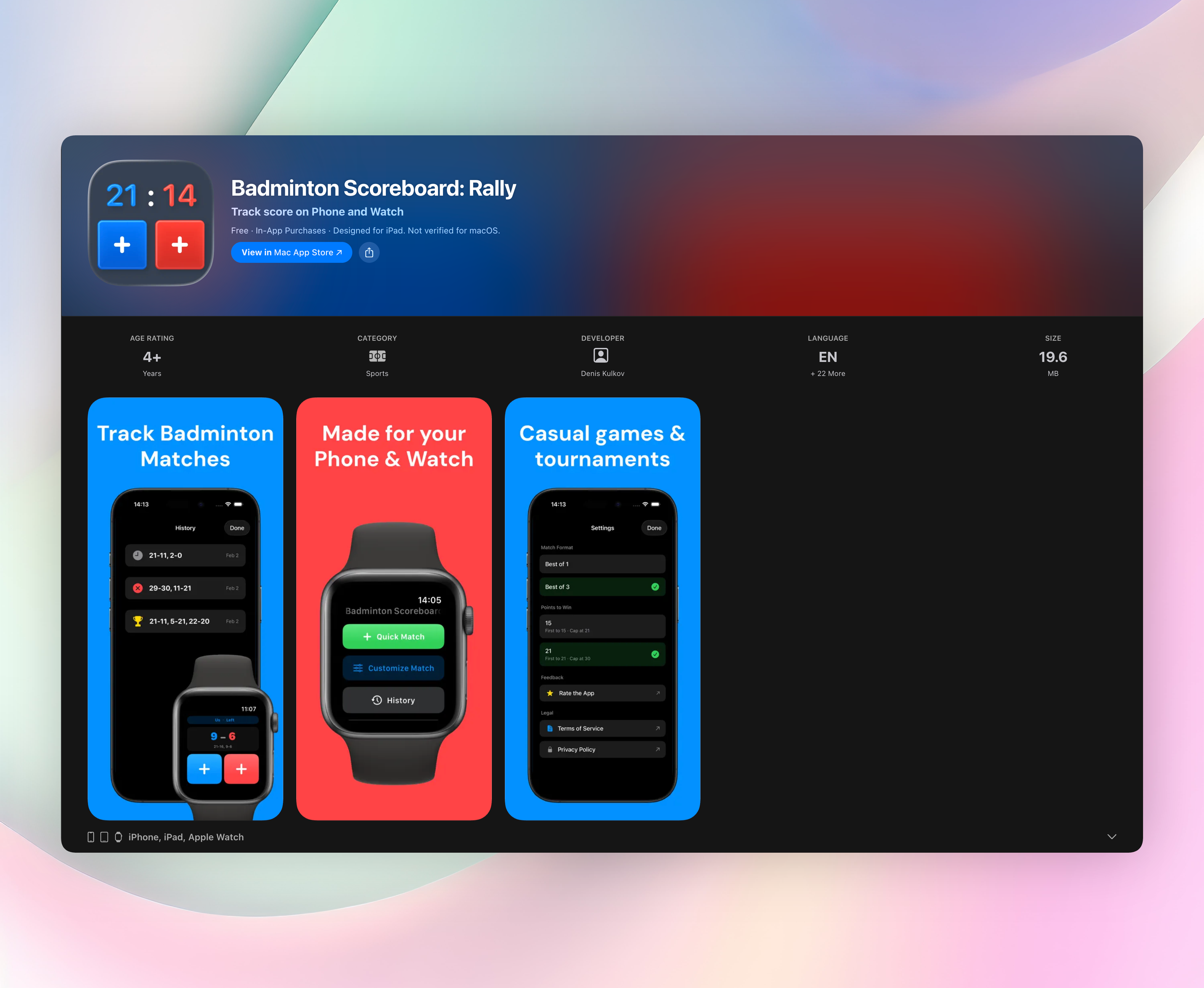
The modern system is easy to lose track of by hand during long rallies — Badminton Scoreboard is a badminton scoreboard app for iPhone and Apple Watch that tracks match scores, so the system this history ends with is the one you watch tick over on your own screen.
The vote that kept 21 points
Rally scoring wasn't the end of the argument. A format of five games to 11 has been floated more than once as a way to make matches shorter and more televisual; it failed to win the majority it needed at the BWF's 2018 annual general meeting, echoing an earlier attempt years before. So the format in any current badminton scoring rules explainer is still 21-point rally scoring, best of three.
A smaller 2018 change is easier to spot from the sideline: a fixed serving height of 1.15 meters above the court, brought in as an experimental law to replace an umpire's judgment about the server's lowest rib.
How to pronounce badminton, and where "poona" survives
Three syllables: BAD-min-tun, stress on the first. The two common mistakes go in opposite directions — dropping the middle "n" for "badmitton," or adding one for "badmington." British speakers often swallow the last vowel, which comes out closer to BAD-min-t'n. The Gloucestershire village and the house are said the same way as the sport.
"Poona" didn't survive in the laws. It isn't in the rulebook, on a scoresheet, or in an umpire's call. It lives on in club names around the world, in Pune's own claim on the sport, and in histories like this one. What did survive from the pre-net era is vocabulary: "shuttlecock" is still the official term, though North American players mostly say "bird" or "birdie," and "battledore" shows up as the archaic word for a racket. If a word in a badminton glossary sounds strange, it usually predates the net.
FAQ
Who invented badminton?
No single person. British officers in India turned battledore and shuttlecock into a net game with scoring during the 1860s, and English clubs codified it in 1877 and 1893. Any source naming one inventor is guessing.
Where did badminton originate?
The modern net game came together in India, around the garrison town of Poona — today's Pune. The name and the first published rules came from England. Both countries have a real claim.
When was badminton invented?
The 1860s for the net game, with the first written English rules in 1877 and a national rulebook in 1893. Its ancestor, battledore and shuttlecock, is centuries older and had no scoring at all.
How do you pronounce badminton?
BAD-min-tun — three syllables, stress on the first, with a clear "n" in the middle. "Badmitton" and "badmington" are the two mistakes you'll hear most often.
Why does badminton use 21 points?
The 21-point rally system replaced the old 15-point service-only scoring in 2006, mainly to make match length more predictable. Proposals to switch to five games of 11 have been floated since, but none has won the vote needed to adopt it.
Free Badminton tools
- Badminton Court Dimensions CalculatorSelect singles or doubles, choose metres or feet, and calculate court length, width, service-line positions, and total area.
- Badminton Net Height GuideUse this badminton net height guide to see the official post and centre heights, a scale diagram and a quick setup checklist.
- Badminton ScoreboardA badminton scoreboard for singles and doubles matches. Tap each rally to show the live score, current server, service court and game history.
- Badminton Scoring Rules ExplainerUse this badminton scoring rules explainer to check rally scoring, the 21-point win condition, deuce extension and end changes for singles or doubles.
- Badminton Service Rules CheckerCheck the correct service court, rotation state and key reminders for a badminton rally using the current scores and match format.
- Round Robin GeneratorCreate a deterministic round robin schedule for any singles or doubles sport, with court assignments, waves, sit-outs, fairness counts and a printable badminton score sheet.
- Shuttlecock Speed TesterRun a birdie test with the landing distance, hall temperature and altitude to see whether a feathered shuttle is too slow, correct pace or too fast.