Badminton vs tennis: what actually differs, and which is harder
The badminton vs tennis question comes down to four things: a much smaller court, a net nearly two feet higher, a feathered shuttle instead of a ball, and one running score to 21 instead of games and sets. Badminton rewards reaction speed and deception. Tennis rewards power and grinding.
Badminton vs tennis: the specs side by side
| Badminton | Tennis | |
|---|---|---|
| Doubles court | 44 × 20 ft (13.4 × 6.1 m) | 78 × 36 ft (23.77 × 10.97 m) |
| Singles court | 44 × 17 ft (13.4 × 5.18 m) | 78 × 27 ft (23.77 × 8.23 m) |
| Net at center | 5 ft (1.524 m) | 3 ft (0.914 m) |
| Projectile | Shuttlecock, 4.74–5.50 g | Ball, 56.0–59.4 g |
| Bounce | None — hit it before it lands | One bounce allowed |
| Racquet, strung | Roughly 80–100 g | Roughly 280–340 g |
| Scoring | Rally point, games to 21 | 15/30/40 → games → sets |
Court size and net height: the difference between badminton and tennis you feel first
A tennis doubles court covers a little over three times the area of a badminton doubles court, and badminton narrows further for singles — 17 ft against 20 ft — without changing length. The badminton court dimensions also include service courts that swap shape between singles and doubles.
The net is where they separate. Badminton's sits at 5 ft in the middle, rising to 5 ft 1 in at the posts; tennis's sags to 3 ft from 3 ft 6 in. You can't hit down from the back of a badminton court, so attacking angles open only as you move forward and close in.
One badminton and tennis difference catches every crossover player: no bounce. The shuttle must be struck before it lands, so there's none of the recovery time a tennis player takes for granted.
Scoring: one count to 21 versus games, sets and tiebreaks
Badminton uses rally scoring — every rally awards a point, whoever served. Games go to 21, win by two, capped at 30, so at 29–29 the next point takes it. Matches are best of three, with a 60-second interval when a side reaches 11. The badminton scoring rules also set which service court you serve from, based on whether your score is even or odd.
Tennis nests four layers: points counted 15, 30, 40, game; games into sets; sets into a match. Deuce runs to advantage, though college and many doubles formats use no-ad scoring instead. Sets go to six games by two, with a tiebreak to seven at 6–6, and final-set rules vary by tournament.
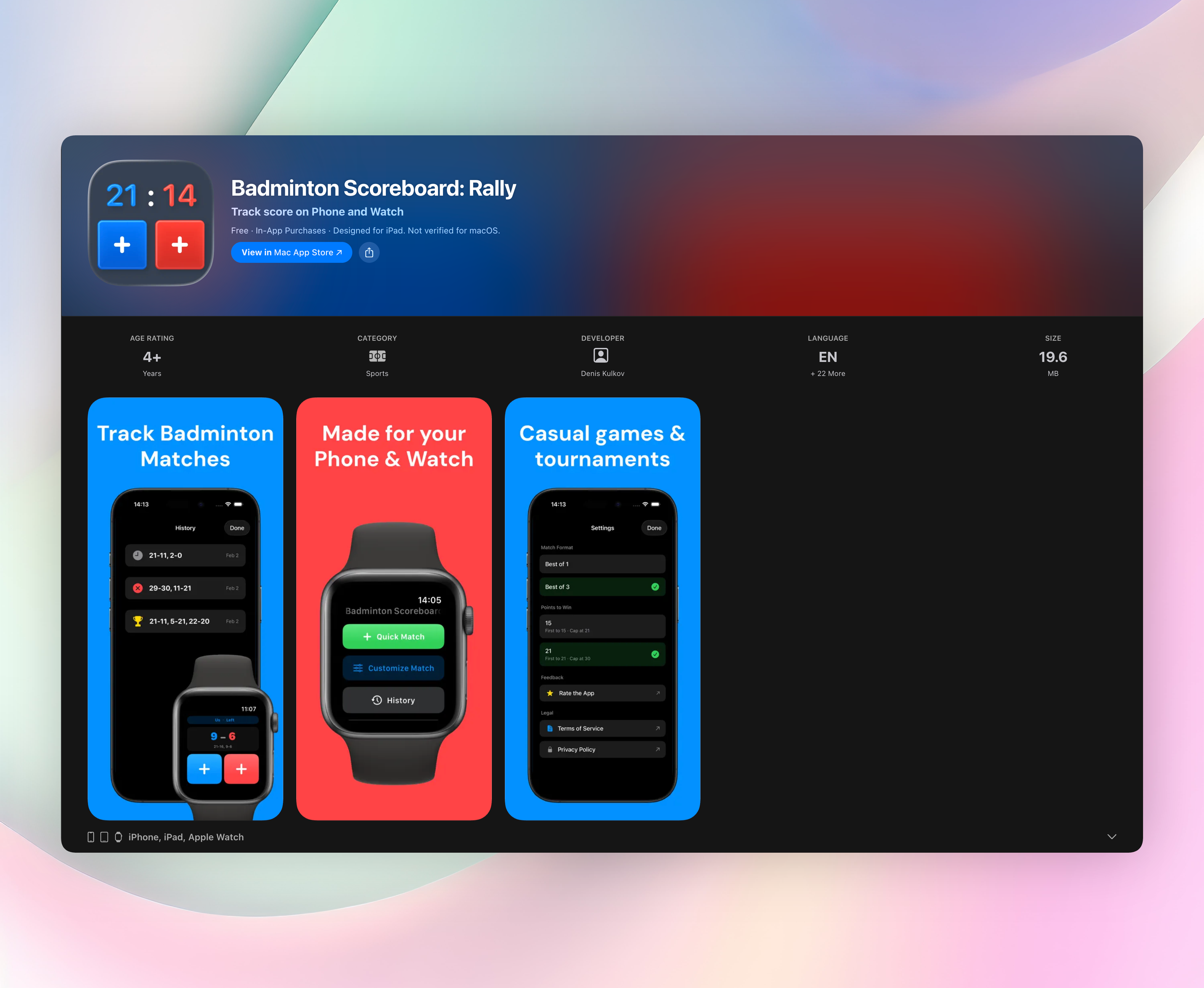
That gap matters courtside. A badminton match is one number per side plus a game count, so a phone or a watch covers it — Badminton Scoreboard is a badminton scoreboard app for iPhone and Apple Watch that tracks match scores, which is all a single running total needs. Tennis, with games nested inside sets and tiebreaks, is the one that needs a complicated display.
Rally length, distance covered and shuttle speed
Badminton rallies are short, dense bursts — the shuttle comes back in a fraction of a second and never bounces, so the pattern is lunge, jump, recover, repeat inside a small box. Distance covered stays modest; the change-of-direction and overhead load does not. Tennis stretches everything out — longer sprints, wider lanes, and a 25-second shot clock between points, 90 seconds at changeovers, two minutes between sets.
Nothing in racquet sport leaves the strings faster than a shuttlecock — smashes have been clocked above 400 km/h in speed tests, well past the fastest tennis serves near 250 km/h — but the feathered skirt creates enormous drag, so the shuttle arrives at the far end at a fraction of that. Badminton wants the fastest reaction at contact; tennis wants you to handle a ball that stays heavy off the bounce.
Cost of entry: badminton or tennis on a budget
Badminton is cheaper to start, pricier to run. A beginner racquet, non-marking indoor shoes and a tube of nylon shuttles last months, but feather shuttles are consumables, and because a draft moves the shuttle, badminton needs paid indoor court time. Tennis costs more up front in racquet and stringing, but public outdoor courts are often free.
Is badminton harder than tennis?
Split into three, it becomes answerable.
Reaction speed
Badminton, clearly. Contact-to-contact times in the front court are shorter than anything in tennis, and there's no bounce to buy you time.
Endurance
Tennis, across a full match. Five sets is a multi-hour effort, often in the sun. Badminton is more intense per minute but compressed into a shorter window with scheduled intervals.
Skill ceiling
Both run deep, in different directions. Tennis's depth is in spin, surface adaptation and building a point over many shots. Badminton's is in deception — hiding a drop and a smash behind identical preparation — and finger control at the net. It's easier to rally in your first hour and much harder to fake later; how to play badminton covers that first session.
Badminton vs pickleball and badminton vs squash
A pickleball court is 20 × 44 ft, the same footprint as a badminton doubles court, but the net sits at 34 in in the center and the ball bounces, so rallies run slower and the learning curve is gentler. Traditional pickleball scores to 11, win by two, points only on serve, with rally scoring in some pro and team formats.
The badminton vs squash comparison runs the other way: an enclosed 9.75 × 6.4 m court with a front wall instead of a net, scored PAR to 11 over a best-of-five, with more continuous rallies and far less overhead work.
FAQ
Which is faster, badminton or tennis?
Badminton, at the moment of contact — a smashed shuttle leaves the racquet faster than any tennis serve, and there's less time to react near the net. A tennis ball is faster at the receiving end, because it holds its pace and a shuttle doesn't.
Is badminton easier to learn than tennis?
For most people, yes, over the first few sessions — light racquet, small court, easier rally. Mastery is another matter: the deception and net play take years.
Can you play badminton on a tennis court?
Not properly. The court is far too large, the net nearly two feet too low, and outdoor air makes the shuttle unpredictable. Portable nets work for garden play; a real match needs an indoor court.
Do tennis skills transfer to badminton?
Partly. Footwork patterns, court awareness and the overhead motion carry over. The grip and swing don't — badminton runs on forearm rotation and finger power through a short stroke, and tennis players arrive with a swing that's far too long.
Free Badminton tools
- Badminton Court Dimensions CalculatorSelect singles or doubles, choose metres or feet, and calculate court length, width, service-line positions, and total area.
- Badminton Net Height GuideUse this badminton net height guide to see the official post and centre heights, a scale diagram and a quick setup checklist.
- Badminton ScoreboardA badminton scoreboard for singles and doubles matches. Tap each rally to show the live score, current server, service court and game history.
- Badminton Scoring Rules ExplainerUse this badminton scoring rules explainer to check rally scoring, the 21-point win condition, deuce extension and end changes for singles or doubles.
- Badminton Service Rules CheckerCheck the correct service court, rotation state and key reminders for a badminton rally using the current scores and match format.
- Round Robin GeneratorCreate a deterministic round robin schedule for any singles or doubles sport, with court assignments, waves, sit-outs, fairness counts and a printable badminton score sheet.
- Shuttlecock Speed TesterRun a birdie test with the landing distance, hall temperature and altitude to see whether a feathered shuttle is too slow, correct pace or too fast.